
Lesson 16
STONE, WORD, BREAD
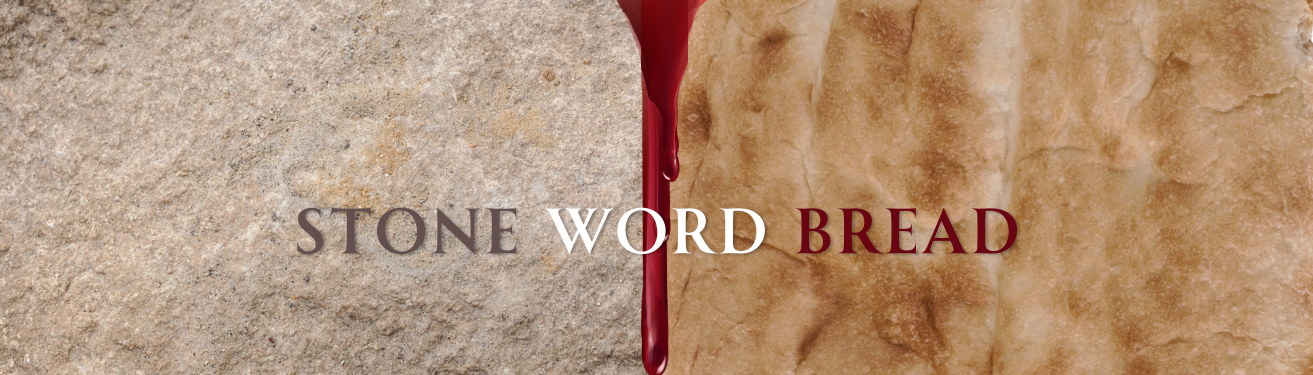
Table of Contents
– “If Thou Be the Son of God…”
– It is Written
– Bread of Life
Scriptures Cited:
Matthew 3:13-17, Matthew 4:1-4, Deuteronomy 8:1-3, Deuteronomy 5:22-26, Deuteronomy 5:6-21, Deuteronomy 5:27-29, Deuteronomy 18:15-19, Acts 3:22, John 1:1, John 1:14, John 6:45-51, John 6:52, John 6:57-58, John 6:63, John 6:68, Luke 2:6-12, Psalm 34:8
“IF THOU BE THE SON OF GOD…”
Before we begin this lesson, I would like to share my appreciation and gratitude to those who have a continued desire to seek and study the truth of God’s Word with us. It is my prayer that these lessons help us all grow closer in our relationship with God through our Lord and savior Jesus Christ. Again, thank you.
This lesson will be the beginning of a theme centered around the temptations of Christ. Many people are familiar with the confrontation between Satan and Christ in the wilderness, after His 40 days of fasting. In these lessons we will use each of the temptations as a starting point to gain a deeper understanding of God’s Word. This being the first lesson of three, our focus will be the Stone, the Word, and the Bread.
As we go through this lesson I ask that you engage your mind and spirit with the scriptures, taking your time with the word of God. Keeping in mind our theme of the stone, the word, and the bread, we’re going to look at a few scriptures, and hopefully gain a deeper insight and understanding into some of things that were going on there in the wilderness during the temptation of Christ.
We will begin in the book of Matthew at the end of chapter 3, where Jesus is baptized (though the temptation account starts in chapter 4). This will give us some context leading into the temptations, and we will also see how this encounter is an example of something that Jesus taught in one of His parables.
Matthew 3:13-17
13 Then cometh Jesus from Galilee to Jordan unto John, to be baptized of him. 14 But John forbad him, saying, I have need to be baptized of thee, and comest thou to me? 15 And Jesus answering said unto him, Suffer it to be so now: for thus it becometh us to fulfil all righteousness. Then he suffered him.
16 And Jesus, when he was baptized, went up straightway out of the water: and, lo, the heavens were opened unto him, and he saw the Spirit of God descending like a dove, and lighting upon him: 17 And lo a voice from heaven, saying, This is my beloved Son, in whom I am well pleased.
Continuing into chapter 4:
Matthew 4:1-4
1 Then was Jesus led up of the Spirit into the wilderness to be tempted of the devil. 2 And when he had fasted forty days and forty nights, he was afterward an hungred. 3 And when the tempter came to him, he said, If thou be the Son of God, command that these stones be made bread. 4 But he answered and said, It is written, Man shall not live by bread alone, but by every word that proceedeth out of the mouth of God.
By looking carefully at these scriptures, it can be seen as an example of something that Jesus taught in the parable of the seed and the sower. In that parable, one of the outcomes was that when the seed (word) is sown, Satan immediately comes and tries to steal that word away. And here we see an example of Satan doing just that.
In chapter 3 after Jesus was baptized in obedience to the Father – verse 17 says “and lo a voice from heaven, saying, This is my beloved Son, in whom I am well pleased.”
Then after Jesus had fasted in chapter 4, we see the devil coming in right away trying to steal the words that God had spoken; Satan asking Jesus the question, “If thou be the Son of God…“
Keep in mind that God had just spoken from Heaven calling Jesus His ‘beloved Son’, and here we see the devil coming right behind Him, wanting Jesus to question what God had told Him. This is a clear example of one of the ways that Satan operates. Neverltheless, Jesus then answers him in verse 4, “It is written, Man shall not live by bread alone, but by every word that proceedeth out of the mouth of God.” And when we look at this answer, it is actually a rather strange response considering what Satan presented to Him.
It is also interesting to note that when Jesus answered Satan ‘man shall not live by bread alone but by every word…’ the Greek word used for ‘word’ is “rhema”, which means the teachings or sayings of God. In other words, man shall live by the sayings of God.
So let’s look further at this answer which Jesus gave to see if there is a deeper meaning than what we normally would get from a casual reading of this passage. Maybe there was more going on there than meets the eye…
IT IS WRITTEN
Jesus answered Satan “It is written…” The question then becomes: Where is that written? Well, “Man shall not live by bread alone, but by every word that proceedeth out of the mouth of God” is actually a scripture from the book of Deuteronomy in chapter 8.
Deuteronomy is the 5th book in the Old Testament and is sometimes referred to as the ‘second telling of the law’. Most are familiar with how the children of Israel were brought out of Egypt, and God gave them the law, which (to put it nicely) they ‘struggled’ with in the wilderness for 40 years. Then when they were finally about to enter the Promised land, there was a retelling of the law, so that they would do well as they entered in. Moses reminded the people of God’s word, His commandments and His law. He also reminded them of what they had gone through during those 40 years in the wilderness.
So if we go to chapter 8, we’re going to start at verse 1 and read until verse 3. This is Moses talking to the people:
Deuteronomy 8:1-3
1 All the commandments which I command thee this day shall ye observe to do, that ye may live, and multiply, and go in and possess the land which the LORD sware unto your fathers. 2 And thou shalt remember all the way which the LORD thy God led thee these forty years in the wilderness, to humble thee, and to prove thee, to know what was in thine heart, whether thou wouldest keep his commandments, or no.
3 And he humbled thee, and suffered thee to hunger, and fed thee with manna, which thou knewest not, neither did thy fathers know; that he might make thee know that man doth not live by bread only, but by every word that proceedeth out of the mouth of the LORD doth man live.
So now we see the context of where that answer came from when Jesus was going toe to toe with Satan. The enemy tried to make Jesus doubt and also wanted to appeal to His flesh and His hunger – but Jesus went right here to Deuteronomy. And this was the answer that He gave to Satan.
As a reminder, I want you to notice the stone, the Word, and the bread as we go through these scriptures.
In the scripture above, we read that God caused the people of Israel to hunger, but He gave them manna from Heaven – or as it is sometimes called ‘bread from Heaven’. That was the bread given to the children of Israel to eat during those 40 years in the wilderness. And it says here that it was given to them, so that they might know that ‘man doth not live by bread alone, but by every word that proceedeth from the mouth of God’.
We will stay here in Deuteronomy and see that there is a reason why Moses was the one speaking to the people instead of God speaking to them directly. If we go back to chapter 5 beginning at verse 22, we will see where God reminds the children of Israel of the time He actually spoke to them directly.
Deuteronomy 5:22-26
22 These words the LORD spake unto all your assembly in the mount
Note: Prior to this verse, Moses gave a retelling of the ten commandments in verses 6 through 21.
22 These words the LORD spake unto all your assembly in the mount out of the midst of the fire, of the cloud, and of the thick darkness, with a great voice: and he added no more. And he wrote them in two tables of stone, and delivered them unto me.
Note: So you see right there that the word of God, the commandments were written in stone. And like I said, we want to be paying attention to the stone, the Word, the bread…
23 And it came to pass, when ye heard the voice out of the midst of the darkness, (for the mountain did burn with fire,) that ye came near unto me, even all the heads of your tribes, and your elders; 24 And ye said, Behold, the LORD our God hath shewed us his glory and his greatness, and we have heard his voice out of the midst of the fire: we have seen this day that God doth talk with man, and he liveth.
25 Now therefore why should we die? for this great fire will consume us: if we hear the voice of the LORD our God any more, then we shall die. 26 For who is there of all flesh, that hath heard the voice of the living God speaking out of the midst of the fire, as we have, and lived?
What we see here is that God had originally spoken the commandments directly to the people, but the voice of God was so powerful and so terrifying that they went to Moses and said ‘Moses, why should we even be here? We’re going to end up dead. How about you go and talk to Him?’ I’m paraphrasing but basically, that’s what is being said here. It tells you how powerful God’s voice is, and was to them at that time.
And so we’ll continue on in verse 27, where Moses reminds the people of what they had said.
Deuteronomy 5:27-29
27 Go thou near, and hear all that the LORD our God shall say: and speak thou unto us all that the LORD our God shall speak unto thee; and we will hear it, and do it.
28 And the LORD heard the voice of your words, when ye spake unto me; and the LORD said unto me, I have heard the voice of the words of this people, which they have spoken unto thee: they have well said all that they have spoken.
Note: So, when God heard them say that, He said ‘Yeah, they’re actually right. They do not want to hear my voice, because it is that powerful. And then God says something very important in verse 29…
29 O that there were such an heart in them, that they would fear me, and keep all my commandments always, that it might be well with them, and with their children for ever!
We see that when the law was given directly from the mouth of God, the Word was too powerful and caused them to say ‘Don’t let God speak to us directly – Moses, you go, you talk to Him and you tell us everything He said and we’ll do it’. And God said that they were wise in saying that.
What I want to do next is look at another reference to this same encounter, given later in the book of Deuteronomy. This will shed more light and point us in the direction that we need to go in this lesson. In Deuteronomy chapter 18, we’re going to go to verse 15 and this is still Moses speaking. He says:
Deuteronomy 18:15-19
15 The LORD thy God will raise up unto thee a Prophet from the midst of thee, of thy brethren, like unto me; unto him ye shall hearken;
Note: This is quoted in the book of Acts when speaking about how Jesus is this prophet that the Lord will raise up.
16 According to all that thou desiredst of the LORD thy God in Horeb in the day of the assembly, saying, Let me not hear again the voice of the LORD my God, neither let me see this great fire any more, that I die not.
17 And the LORD said unto me, They have well spoken that which they have spoken.18 I will raise them up a Prophet from among their brethren, like unto thee, and will put my words in his mouth; and he shall speak unto them all that I shall command him.
19 And it shall come to pass, that whosoever will not hearken unto my words which he shall speak in my name, I will require it of him.
So, here we see that God added a bit to what we read earlier. When the people came to Moses and said that they did not want to hear the voice of God anymore, God had an answer for that: He was going to raise up a prophet like Moses and put His words in His mouth. And according to Acts chapter 3 verse 22, Peter lets us know on the day of Pentecost that this prophet who was prophesied to come, is Jesus.
Next we will look at how God accomplished what He said He would do. We have so far seen that the commandments or the “words of God” were put in stone, and now God was going to “raise up a prophet” and put His Word in that prophet’s mouth. In John chapter 1, we read:
John 1:1
1 In the beginning was the Word, and the Word was with God, and the Word was God.
Remembering that our focus here is the stone, the word, and the bread… here we see the Word. And if we skip down to verse 14 it says:
John 1:14
14 And the Word was made flesh, and dwelt among us, (and we beheld his glory, the glory as of the only begotten of the Father,) full of grace and truth.
So now we can see that in response to the children of Israel not wanting to hear God’s voice, God literally sent His Word. That powerful Word that they could not bear to hear, God made that word flesh. And it came and dwelt among us and spoke to us the words of God. Like we read “I will put my words in His mouth”.
It is amazing when we really understand what God did. It is almost as if He said, ‘I’m going to do you one better. Not only am I just going to put My words in His mouth, I am actually going to first take my Word and make it flesh and then put My words in His mouth.’
So let’s stay here in the book of John and see what this Word that was made flesh, had to say about Himself. In John chapter 6, starting in verse 45, we see Jesus speaking…
John 6:45-51
45 It is written in the prophets, And they shall be all taught of God. Every man therefore that hath heard, and hath learned of the Father, cometh unto me. 46 Not that any man hath seen the Father, save he which is of God, he hath seen the Father.
47 Verily, verily, I say unto you, He that believeth on me hath everlasting life.
48 I am that bread of life.
49 Your fathers did eat manna in the wilderness, and are dead. 50 This is the bread which cometh down from heaven, that a man may eat thereof, and not die.
51 I am the living bread which came down from heaven: if any man eat of this bread, he shall live for ever: and the bread that I will give is my flesh, which I will give for the life of the world.
Hopefully you are staring to see the picture that is being painted of how the stone and the word and the bread are all connected.
When Satan came to Jesus and said ‘Turn this stone into bread’, there is a deeper meaning to what was actually going on and what was being said. Unbeknownst to Satan, God had already ‘turned the stone to bread’.
But staying here in John chapter 6 – after the people heard Jesus say that He is the bread that came down from heaven, they ask a very important question in verse 52:
John 6:52
52 The Jews therefore strove among themselves, saying, How can this man give us his flesh to eat?
That is a question that we really need to ask ourselves. Jesus says that He is the bread of life, so then the question is how do we eat that bread? What does He mean?
A few verses later, Jesus will give us some more information to help answer that question. But before we get to that, let’s skip down to verse 57, where Jesus again makes reference to what we read in Deuteronomy.
John 6:57-58
57 As the living Father hath sent me, and I live by the Father: so he that eateth me, even he shall live by me.
58 This is that bread which came down from heaven: not as your fathers did eat manna, and are dead: he that eateth of this bread shall live for ever.
These are the words of Jesus – that Word which was made flesh. And what that Word tells us is that He is actually the bread of life. The commandments that were written in stone – the Word of God which gives life, was made flesh and was given as our ‘bread’ that we might eat and live.
Now in verse 63, Jesus gives us the information that we need to understand more fully, what He means in all of this.
John 6:63
63 It is the spirit that quickeneth; the flesh profiteth nothing: the words that I speak unto you, they are spirit, and they are life.
Now we see that the words of Jesus and the things that He taught are Spirit and they are Life. Remember, God said He would raise up a prophet and put His words in His mouth. The words of Jesus are the very words of God. And whoever does not harken to His words will have to give an account to God (Deuteronomy 18:19).
If we keep reading, we see that Peter understood what Jesus meant. When the 12 apostles were asked if they would also leave Jesus as did those who did not believe, Peter answered…
John 6:68
68 Then Simon Peter answered him, Lord, to whom shall we go? thou hast the words of eternal life.
Let’s now go to one other place, just to bring the point home of who Jesus is in this context, but in a different way.
BREAD OF LIFE
In Luke chapter 2 starting in verse 6, we read about the birth of Jesus.
Luke 2:6-12
6 And so it was, that, while they were there, the days were accomplished that she should be delivered. 7 And she brought forth her firstborn son, and wrapped him in swaddling clothes, and laid him in a manger; because there was no room for them in the inn. 8 And there were in the same country shepherds abiding in the field, keeping watch over their flock by night.
9 And, lo, the angel of the Lord came upon them, and the glory of the Lord shone round about them: and they were sore afraid. 10 And the angel said unto them, Fear not: for, behold, I bring you good tidings of great joy, which shall be to all people. 11 For unto you is born this day in the city of David a Saviour, which is Christ the Lord.
12 And this shall be a sign unto you; Ye shall find the babe wrapped in swaddling clothes, lying in a manger.
You are now probably wondering, ‘How does that bring the point home of anything?…What are you talking about?’
Well, the reason that this brings the point home of Jesus being the ‘bread of life’ that was given for us to “eat and consume”… is because when Jesus was born, Joseph and Mary had to stay where the animals are kept because there was no room for them in the inn. There, Jesus was laid in a “manger”, which is actually a trough where food is placed for animals to come feed.
I’ve heard it put very well that when Jesus was born, He basically came out of the womb and was placed on a ‘plate’. And it was the kind of plate where all the ‘wild animals’ could come and feed. So, right from the beginning, Jesus was and is the bread of life – given to us that we might eat and live.
We will leave it right there for now, though there are some other verses we could go to about partaking of this bread of life. As it says in Psalm 34:8, “O taste and see that the LORD is good: blessed is the man that trusteth in him”.
Hopefully through this lesson “Stone, Word, Bread”, you have found yet another way to see our Lord and Savior Jesus Christ. I encourage you to think on these scriptures, in order to have a broader and deeper understanding of what Jesus meant when He said that He is the bread of life.
Once again, the invitation is extended for you to come to Christ in the way that it is shown throughout the Bible. If you believe the gospel that Jesus is who He said He is – and that He gave His life for us that we might live… the way that we accept that is by being baptized in His name for the remission of our sins, and receiving the gift of the Holy Spirit.
Feel free to contact us and we will help you in any way possible in your journey with God.
 HisWay